FY2025 Business Overview of Consumer Co-ops Nationwide
2026.02.26
JCCU has announced the business overview of community-based consumer co-ops nationwide. In response to continued price increases this fiscal year, the organization plans to further strengthen measures that support members' daily lives, from both the price and value perspectives.
Home Delivery Business (April to November)
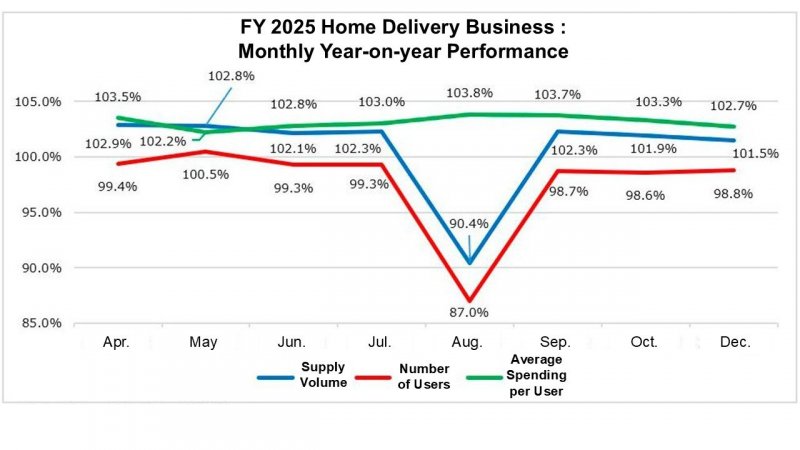
Although the number of users fell below the previous year's level, average spending per user increased due to price hikes that raised unit prices. As a result, overall supply volume reached 100.5% year on year, exceeding the previous year's level.
Order volume also reached 100.5% year-on-year, and average spending per user rose to 103.1%, while the number of users stood at 97.7% and the number of items purchased at 96.9% of the previous year's levels.
The decline in door-to-door visits, which had previously been a primary enrollment channel, together with the failure of user numbers to recover after long holiday periods such as the summer break, dropping into the 98% range, has made securing and maintaining user numbers a key challenge.
As part of its home delivery business initiatives, a "Home Delivery Center Standardization School" was organized to help standardize operations and improve productivity, with 12 consumer co-ops from across the country participating. To encourage new member enrollment, successful case examples and practical know-how are also being shared nationwide. In addition, efforts are underway to develop new membership channels and strengthen organizational capacity through the use of digital tools and the creation of specialized sales teams.
Store Business (April to November)
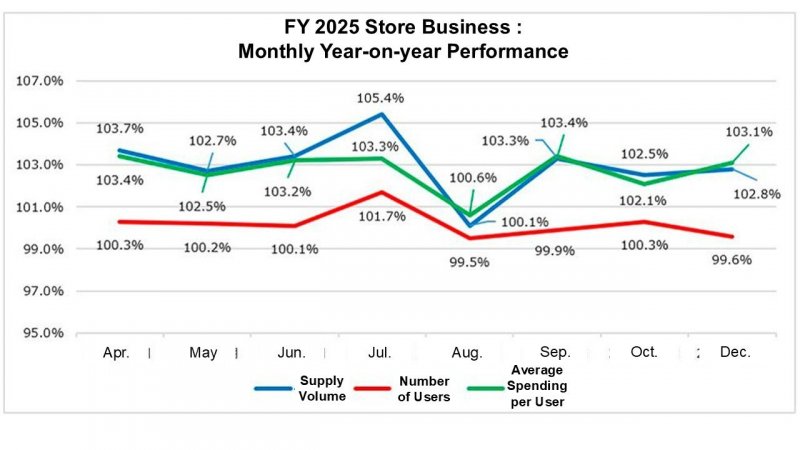
The total supply volume of the 48 major community-based consumer co-ops reached 102.9% year-on-year. This sales growth was mainly driven by rising unit prices, particularly due to the sharp increase in rice prices and overall food price inflation.
Overall supply volume increased to 102.9% year-on-year, average spending per user rose to 102.7%, and the number of users slightly increased to 100.2%. However, the number of items purchased, which is an indicator of actual purchasing volume, fell to 98.4% year-on-year and continues to remain below the previous year's level. This reflects the persistent cost-consciousness of co-op members.
Regarding store development, rising construction costs and the difficulty of securing suitable locations limited new store openings to four. Instead, priority has been given to rebuilding, renovating, and upgrading existing stores.
In terms of sales floor planning, product assortments have been reviewed to better match current shopping needs. As a result, fresh food sections have expanded, and both the sales space and product range for prepared foods and frozen foods have also grown. Additionally, the introduction of self-checkout systems and automated ordering systems is progressing. In the existing stores, the establishment of home-delivery stations, where products ordered through home delivery services can be collected at the store, is expanding, improving convenience for co-op members while also creating additional incentives for store visits.
JCCU (April to December)
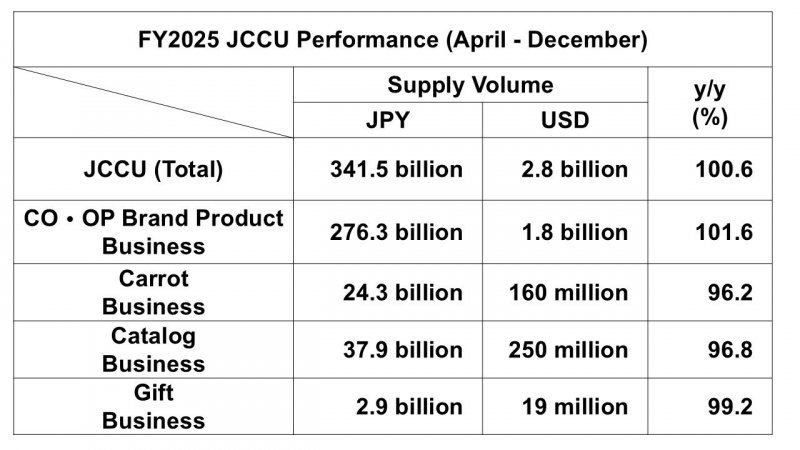
Total supply volume reached 341.5 billion yen (approximately USD 280 million), reaching 100.6% year on year and slightly exceeding the previous year's level.
By business category, the CO・OP Brand Product Business recorded a supply volume of 276.3 billion yen (approximately USD 1.84 billion), representing 101.6% year on year. The Carrot Business, which mainly handles NB products such as daily goods and consumables, recorded a supply volume of 24.3 billion yen (approximately USD 160 million), or 96.2% year-on-year.
The Catalog Business, which deals primarily with apparel and related items, posteda supply volume of 37.9 billion yen (approximately USD 250 million), or 96.8% year-on-year, while the Gift Business, which mainly handles seasonal items such as mid-year gifts (ochugen), year-end gifts (oseibo), and other food-related seasonal products, recorded a supply volume of 2.9 billion yen (approximately USD 19 million), equivalent to 99.2% year-on-year.