Miyagi Prefectural Consumers' Co-operative Union Holds Seminar on Avoiding Online Troubles
2026.08.12
On July 7, the Miyagi Prefectural Consumers' Co-operative Union held a seminar entitled "How to Avoid Online Troubles Lurking Around Us: Using Social Media and the Internet Without Fear." The seminar was organized by the Miyagi Council for the Promotion of Enhanced Consumer Administration (hereinafter referred to as the "Consumer Council") and supported by Miyagi Prefecture and Sendai City.
The number of consumer affairs consultations received by local consumer affairs centers and related organizations across Japan reached approximately 900,000 in 2024, remaining at a consistently high level. Financial losses from consumer troubles in 2025 are estimated to have reached a record ¥9 trillion.
As digital technologies become increasingly integrated into everyday life, new forms of consumer problems linked to online shopping and digital services continue to emerge. Fraud involving the misuse of artificial intelligence (AI) has become more common. In addition, issues such as subscription-related scams, side-job fraud, and investment scams are spreading through social media platforms.
There have also been cases in which individuals applied for what appeared to be ordinary part-time jobs, only to discover that they were in fact being recruited for so-called "illegal part-time jobs"--criminal activities disguised as high-paying employment opportunities. These incidents highlight the growing impact of online consumer fraud on people of all ages.
The Miyagi Prefectural Consumers' Co-operative Union held a seminar on July 7 to help participants learn how to use social media and the Internet safely and securely, as well as how to respond if they become victims of consumer-related troubles. A total of 32 people, including co-op members and staff, attended the seminar, eight of whom participated online.
At the beginning of the event, KONO Yukiko, Vice Chairperson of Miyagi Co-op and Chair of the Consumer Council, delivered opening remarks. The seminar was then conducted by attorney MIYAKOSHI Hidehiro, who served as the guest lecturer.
In his opening comments, he stated, "I hope today's seminar will help you recognize the traps hidden within social media and develop your 'consumer literacy.'" He explained that consumer fraud is not caused solely by a lack of knowledge. Social media platforms are designed with characteristics and mechanisms that can unconsciously influence users and lead them into harmful situations. He then introduced various methods and case studies of consumer fraud, which have been increasing rapidly in recent years.
He further emphasized that the motives of scammers are not limited to obtaining money, and that victims are not only older adults but an increasing number of young people as well. He encouraged consumers to establish their own personal rules to prevent becoming victims and stressed that no one can truthfully say, "I will never be deceived."
The seminar also provided guidance on what actions to take if one becomes a victim of online fraud. Concluding his presentation, Mr. Miyakoshi encouraged participants to "use the Internet wisely and cultivate consumer literacy to prevent becoming victims in the first place."
The seminar was very well received by participants. Numerous questions were raised during the session, and participant surveys included comments such as, "The advice on how to respond was extremely helpful," and "I learned how sophisticated the Internet fraud has become."
Social media and the Internet are convenient tools that enrich our daily lives. It is important that we use them wisely and continue to strengthen our consumer literacy so that consumers can work together to prevent online troubles.
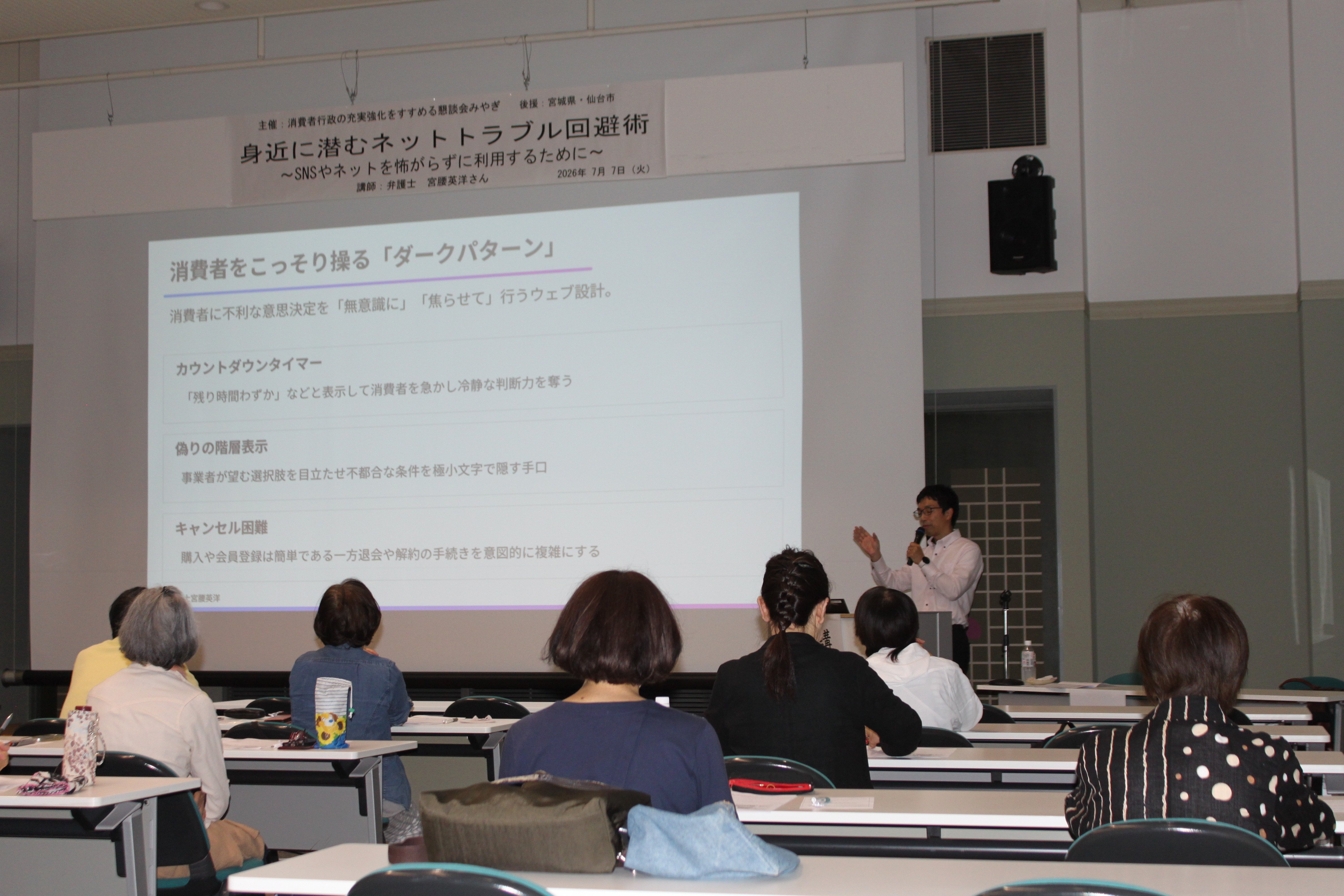
Scene from the Seminar