JCCU Participates for the First Time in a Social Project Supporting LGBTQ People
2026.08.06
In conjunction with Pride Month in June, JCCU carried out a series of initiatives aimed at promoting greater understanding of LGBTQ people and other sexual minorities while fostering a society that respects diversity. These efforts form part of JCCU's commitment to gender equality and building an inclusive organization where people from diverse backgrounds can thrive, as outlined in its Co-op Vision 2030 and SDGs Action Declaration.
To reaffirm the importance of respecting each individual's uniqueness and values, JCCU implemented the following key initiatives.
As part of these efforts, JCCU became a first-time supporting partner of Pride Action 30 in 2026, providing its support without receiving sponsorship benefits or compensation. Pride Action 30 is a collaborative initiative in which companies work together to promote understanding and support for LGBTQ people and foster a society that embraces diversity.
The project aims to create workplaces where everyone can work with confidence and authenticity by promoting 30 practical actions (Pride Actions) that individuals and organizations can take immediately. JCCU shared these actions with its staff, encouraging them to learn about and put them into practice.
「Pride action30」
- Research what each letter in the acronym LGBTQ stands for.
- When referring to a boyfriend, girlfriend, or spouse, try using the gender-neutral term "partner."
- When addressing colleagues or subordinates in the workplace, try using the respectful honorific "-san" instead of gender-specific forms such as "-chan" or "-kun."
- Recognize that approximately one in ten people in society identify as a sexual minority.
- Research the meaning and role of an ally, a person who understands and supports sexual minorities.
- After learning what it means to be an ally, try wearing rainbow-coloured items to show solidarity with sexual minorities.
- Try incorporating rainbow colours, which symbolize support for the rights of sexual minorities, into your social media profile image or online meeting background.
- Be mindful of avoiding expressions based on traditional gender stereotypes, such as "being manly" or "being feminine."
- Research the Progress Pride Flag, which adds colours representing transgender people and racial minorities to the traditional rainbow flag.
- Be aware that approximately 80% of sexual minorities have not disclosed their sexual orientation or gender identity in the workplace.
- Understand that some people do not wish to disclose their sexual orientation or gender identity to others.
- Recognize that you must never engage in outing--revealing another person's sexual orientation or gender identity to a third party without their clear permission.
- Even when you do not fully understand another person's gender identity or sexual orientation, try not to reject or deny it.
- Live with the awareness that there may be sexual minorities in your immediate surroundings who have simply not disclosed their identity to others.
- Imagine the difficulties you might face if the gender you identify with did not match the gender recorded in your official family register.
- Research how the singular pronoun "they" is used in English to refer to people whose gender identity is not limited to the traditional categories of male or female.
- Imagine what you would say to support a family member or colleague who disclosed their sexual orientation or gender identity to you.
- Consider why Japan has received the second-lowest rating among OECD countries for its legal protections for sexual minorities.
- Check whether your employer's internal policies and employee benefits apply equally to sexual minorities and same-sex partners.
- Research what the "X" designation in the gender field of passports means and why it is increasingly being introduced in countries around the world.
- Recognize that some people do not experience sexual attraction to others, while others do not experience romantic attraction.
- Find out whether the local government in your area has introduced a partnership system that officially recognizes same-sex couples.
- Consider planning to attend a local Pride parade, an event that raises awareness of the rights of sexual minorities.
- Discuss with someone why Japan remains the only G7 country that does not legally recognize marriage equality, including same-sex marriage.
- Research the legal requirements that people in Japan must meet to change the gender recorded in their official family register.
- Listen to the well-known speech delivered by former New Zealand Member of Parliament Maurice Williamson during the debate on the same-sex marriage bill.
- When you hear offensive comments or jokes targeting sexual minorities, try pointing out that such language is inappropriate.
- Read And Tango Makes Three, a picture book based on the true story of two male penguins that worked together to hatch an egg and raise a chick as a family.
- Discuss different forms of family life beyond traditional family structures with your family members or colleagues.
- Think about what you can personally do to respect diversity, and continue taking action not only during Pride Month but throughout the year.
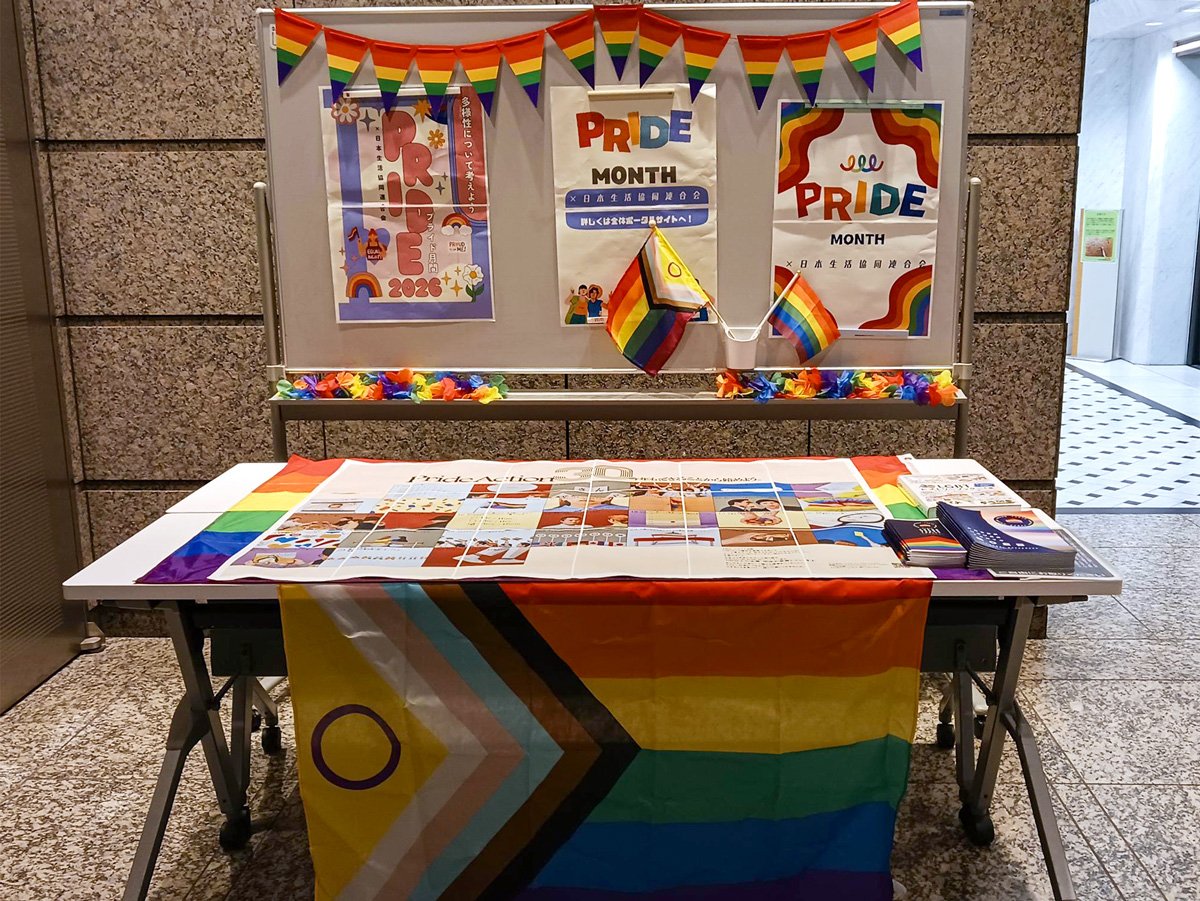
JCCU also decorated its headquarters building, Co-op Plaza, with rainbow colours, the symbol of Pride Month. Displays introducing the Pride Action 30 initiative were installed throughout the building, visually communicating messages of diversity and inclusion to staff members and visitors.
JCCU is also promoting initiatives to expand understanding and support for sexual minorities throughout the organization. These efforts include providing learning opportunities and information for officers and staff, as well as recruiting allies--individuals who actively support LGBTQ people.
In addition, since April 2022, JCCU has extended eligibility for its employee welfare and benefits programs to include same-sex partners and their families. As a result, employees in de facto marital relationships are eligible for benefits such as bereavement and special leave, childcare and family care leave, and allowances for employees who are transferred away from their families, regardless of the gender of their partner.